For most people, coaching athletics probably doesn’t immediately suggest the need for a van.
A stopwatch, a few cones, perhaps some starting blocks and a bag of equipment seem like they should be enough. For Steve Dodt, that was more or less how it started. Training equipment went into the back of the car, came out at the track, and went home again at the end of the session.
Over time, however, both the coaching and the environment around it changed. Starting blocks were joined by sleds, wickets, timing gates, hurdles, resistance equipment, jump boxes, strength equipment, recovery tools and all the smaller pieces that gradually become part of a performance program.
Eventually, the question before training wasn’t simply what Steve wanted to coach. It was what could physically fit in the car.
That might sound like a logistical problem rather than a coaching one, but it raises an interesting question. Should a training session be determined by the equipment and environment that happen to be available, or should those things support the session an athlete actually needs?
That is where the FAST Buzz comes into the story.
Coaching Isn’t a Place
Steve is Head Performance Coach at FAST Running in Canberra, where athletes train across a range of environments rather than being tied exclusively to one athletics track.
There are sessions where a synthetic track is exactly what is required. There are others where a hill provides the appropriate environment, grass works perfectly well, or a gym becomes part of the training week. FAST athletes have become accustomed to moving between those environments according to the purpose of the session.
The coaching principle behind that is relatively simple. A venue is a tool.
Good coaching shouldn’t depend on standing at one particular track. What matters is understanding what an athlete is trying to develop and then selecting the environment, training stimulus and tools that best support it.
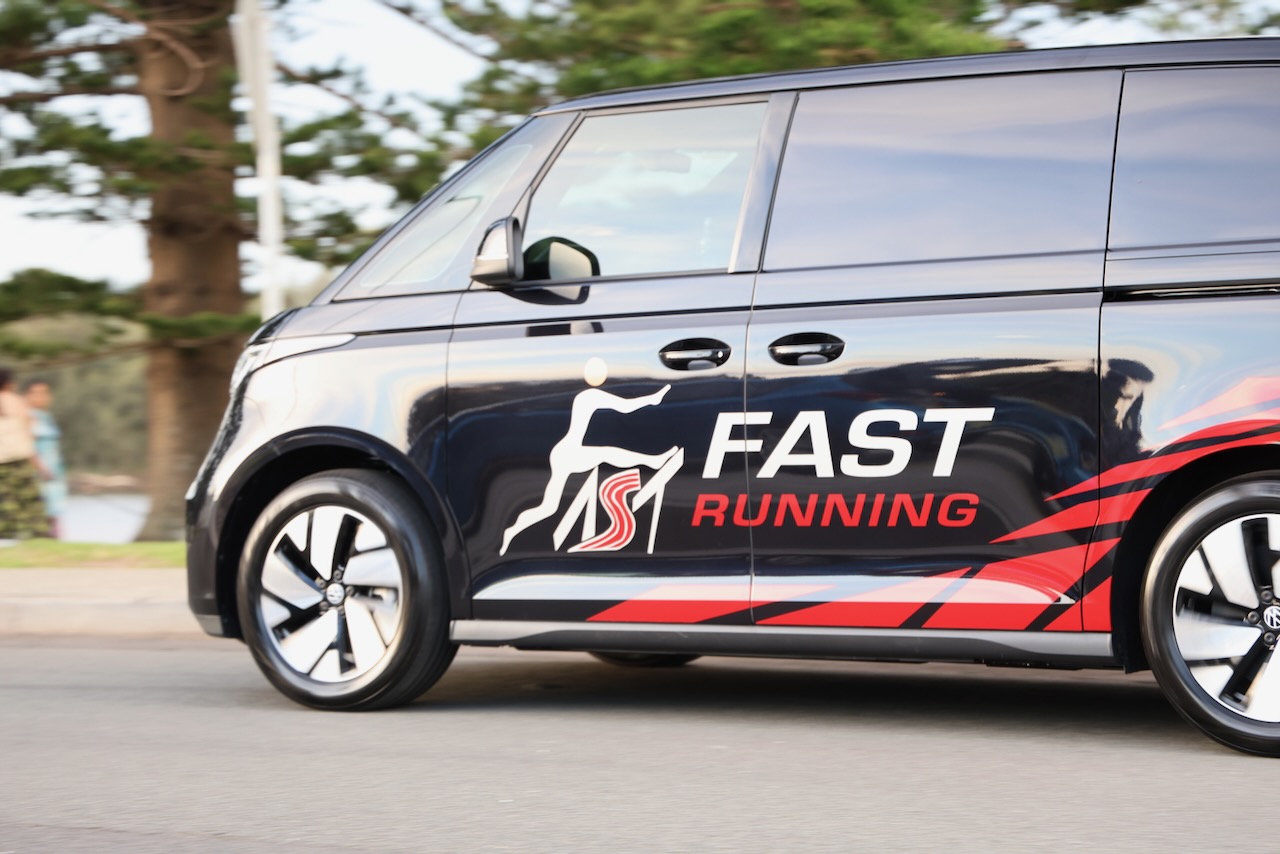
The FAST Buzz — a Volkswagen ID. Buzz Cargo — provides a way of taking much more of that training environment with the coach.
What’s Actually in the Buzz?
Opening the rear doors gives a reasonable indication of just how much the modern FAST training environment has grown.
Starting blocks and sleds support acceleration work. Wickets, markers, video and electronic timing equipment help with maximum velocity development and measurement. Hurdles support both hurdle athletes and technical sprint activities, while jump equipment allows FAST’s horizontal jump program to operate across different training environments.
There is resistance and strength equipment, cones, bands and the collection of smaller tools that can turn out to be surprisingly important once a session begins. Recovery equipment has increasingly found its way into the Buzz as well, particularly when athletes are competing or training away from their usual environment.
Not everything comes out at every session, nor should it.
The point isn’t to surround athletes with as much equipment and technology as possible. Some of the most useful coaching interventions require almost nothing. Equipment earns its place when it helps create an appropriate stimulus, allows something to be measured more accurately, assists an athlete in understanding a movement or simply makes it possible to deliver the intended session in a particular environment.
Technology and equipment should serve the athlete, rather than the athlete existing to justify the technology.
A Mobile Performance Environment
That distinction is important to Steve’s coaching philosophy.
His approach is athlete-centred and evidence-based, but neither of those things means every session needs to look complicated. The starting point is the athlete: where they are in their development, what their event requires, what they have already done and what they need next.
For a sprinter, that might mean acceleration or maximum velocity. For a hurdler, the priority may be rhythm or a particular technical problem. A horizontal jumper may need to work on approach consistency or the relationship between speed and take-off. Another athlete may simply need less work because their competition or training load tells a different story.
The Buzz doesn’t make those decisions.
It simply means that once the decision has been made, Steve is less constrained by what happened to fit in the boot that morning.
That becomes particularly useful when coaching across multiple venues. Instead of rebuilding a training environment from scratch each time FAST moves, much of it can travel with the program.
Canberra’s Changing Training Landscape
The timing of the Buzz has turned out to be particularly useful.
With the AIS athletics facilities unavailable for an extended period during the 2026–27 season, FAST has needed to plan for training across different Canberra locations. That creates obvious logistical challenges for a program accustomed to having athletes, coaches and equipment operating from a major athletics facility.
Moving the athletes is relatively straightforward. Moving everything needed to support them is another matter.
The Buzz allows blocks, hurdles, timing equipment and other training tools to move between venues rather than requiring the program to be redesigned simply because the location has changed.
In that sense, it has become less a van full of athletics equipment and more a mobile performance environment.
The track may change. The coaching standards don’t need to.
Apparently Coaches Need to Understand Load Restraint Too
Of course, buying a van didn’t solve every logistical problem. In some respects, it simply created several new ones.
Once jump boxes, starting blocks, storage containers and training equipment began filling the cargo area, Steve discovered that another skill had apparently been added to the requirements of performance coaching: working out how to stop all of it moving whenever the Buzz turned a corner.
The storage system has consequently evolved almost as quickly as the equipment collection itself. Tie-down points, straps, modular boxes and different loading arrangements have all been tested as Steve has worked out what needs to be permanently carried, what needs to remain quickly accessible and what has to come in and out several times each week.
There is nothing particularly glamorous about that side of high-performance coaching.
But there is something quite representative about it.
A large part of coaching happens away from the moments people normally associate with coaching. Sessions need to be planned. Equipment needs to be ready. Venues need to work. Athletes need to know where they are going. Problems need to be anticipated before they become the athlete’s problem.
Sometimes athlete-centred coaching looks like analysing sprint mechanics.
Sometimes it looks like spending far too long working out where to put a starting block.
Athletes First
That ultimately explains why a sprint coach needs a van.
The Buzz isn’t the coaching. Neither are the starting blocks, timing gates, hurdles, jump boxes, cameras, sleds or recovery equipment packed inside it.
Coaching remains a relationship between coach and athlete. It requires understanding the person in front of the coach, making good decisions, communicating those decisions and creating an environment in which that athlete has the opportunity to improve.
For Steve, the FAST Buzz simply provides a better way of bringing more of that environment with him.
It also represents something that has become increasingly important as FAST Running has grown. Running Excellence isn’t tied to a particular track, piece of equipment or postcode. The environment can change while the principles remain consistent.
And if Running Excellence isn’t tied to one particular track, perhaps it makes sense that sometimes it arrives in a black electric van.
Comments are closed